

Itáliai reneszánsz és barokk festészet (állandó kiállítás)
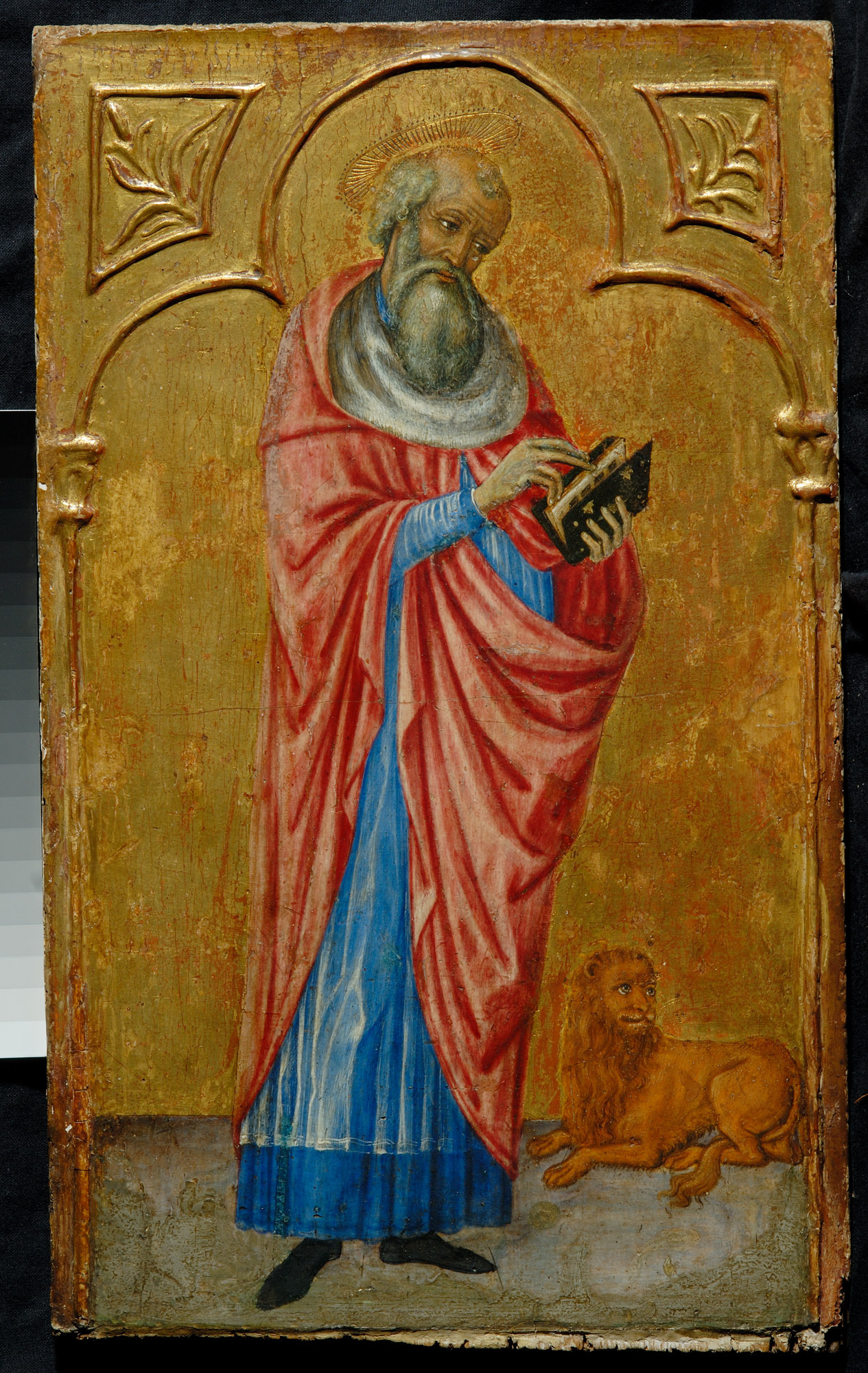
Szent Jeromos
Predella részlet
Alkotó
Matteo di Giovanni
Borgo San Sepolcro, 1430 k. – Siena, 1495
Borgo San Sepolcro, 1430 k. – Siena, 1495
Készítés ideje
1465–1475 körül
Megnevezés
festmény
Anyag
fa
Technika
tempera
Méretek
magasság: 41 cm
szélesség: 25 cm
szélesség: 25 cm
Leltári szám
55.177
Leírás és további adatok
Proveniencia
Ipolyi Arnold püspök vásárlás a kölni Ramboux hagyatékból 1867-ben
Restaurálás
1959 Varga Dezső
Irodalom
- Sallay, Dóra: Corpus of Sienese Paintings in Hungary, 1420–1510. Florence, Centro Di, 2015. kat. 20, 207-2013.
- Rowlands 2013, 9–13, 16–17 nn. 27, 30, 31, 37 (c. 1455–60, pilaster base from an unknown altarpiece, companion piece to the Saint Nicholas and four other pilaster figures by Matteo di Giovanni)
- Dóra Sallay, in Syson et al. 2013 (pilaster base, perhaps from the Asciano al tarpiece);
- Sallay 2008, 7–8, 11, 16, repr. (pilaster base, perhaps from the Asciano altarpiece)
- Riccardo Massagli, in Boskovits and Tripps ed. 2008, 164–65, cat. 30 (c. 1455–60, fragment of a pilaster or a panel projecting between predella scenes);
- Luke Syson, in Syson et al. 2007, 124–31, esp. 131 (cites communication from the present writer that the Saint Jerome and the Saint Nicholas were pilaster bases and may have belonged to the Asciano altarpiece);
- formed part of a predella or the framing structure of an altar piece);
- Nemzeti kincsek 2006, 103, cat. 6-35 (after 1460 [?];
- Kier and Zehnder ed. 1998, 568, no. 169 (c. 1460–70, reconstruction of the Ramboux collection);
- Vilmos Tátrai, in Cséfalvay ed. 1993, 238, no. 105, pl. 105 (1460–70);
- Cséfalvay 1989, 104;
- Trimpi 1987, I, 138–39, II, fig. 117;
- Mucsi 1975, 43, no. 202, fig. 42 (pilaster fragment, 1460s);
- Boskovits 1968 and Boskovits 1978, no. 21 (probably 1460s);
- Berenson 1968, I, 258 (“from portable altarpiece?”);
- Miklós Mojzer, in Boskovits, Mojzer, and Mucsi 1964, 60, fig. III/44 (probably an early work, c. 1460–70, close to the Sansepolcro altarpiece, fragment of a pilaster);
- Mojzer 1964[a], 2–4, no. 8, fig. 6 (first half of 1460s; identifies the companion piece in Altenburg);
- Mojzer 1958, 8; Zeri 1964, 47, fig. 11 on p. 48 (identifies the companion piece in Altenburg);
- Genthon 1948, 79, fig. 92 on p. 81;
- Van Marle 1923–38, XVI (1937), 358;
- Gerevich 1930[a], 95, 99;